is southern Laos’s vibrant gateway to the Mekong and Bolaven Plateau, combines riverside charm, French colonial heritage, lively markets, and easy access to Wat Phou, waterfalls, coffee plantations, and ancient cultural sites.
Pakse is the principal city and transport hub of southern Laos, situated at the confluence of the Mekong and Xe Don rivers. It is the capital of Champasak Province and an excellent base for exploring the region’s diverse attractions. Although Pakse is a relatively modern and unhurried provincial city, it has a distinctly Lao character, with riverside promenades, colourful markets, Buddhist temples, cafés and remnants of French colonial architecture. The surrounding area offers remarkable contrasts, from the cool, forested Bolaven Plateau and its coffee plantations and waterfalls to the mighty Mekong and the islands of Si Phan Don, or the 4,000 Islands. Pakse is therefore particularly well suited to travellers wanting to explore southern Laos beyond the country’s better-known northern destinations.
One of the region’s greatest attractions is Wat Phou, an ancient Khmer temple complex located near the small riverside town of Champasak, approximately 35–50 kilometres from Pakse depending on the route. Dating from a long period of development between the 5th and 15th centuries, the complex was closely associated with the Khmer Empire and was constructed along a remarkable sacred landscape stretching from the Mekong towards Phou Kao Mountain. Its temples, shrines, reservoirs, stone carvings and ceremonial pathways reflect Hindu beliefs concerning the relationship between mountains, water and the divine. Wat Phou and its associated ancient settlements were inscribed as a UNESCO World Heritage Site in 2001 and form one of the most important archaeological landscapes in Laos.
Pakse is easily reached by domestic flights to Pakse International Airport, while long-distance buses and overnight services connect the city with Vientiane and other destinations in Laos. From Pakse, Champasak can generally be reached by road in around 45–75 minutes by minivan, bus or private vehicle; local transport and organised tours can then take visitors onwards to Wat Phou, about 10 kilometres from Champasak town. Travellers can also explore the area by motorbike or tuk-tuk, while some operators offer combined day trips. For those with more time, staying in Champasak provides a quieter experience of the Mekong, traditional Lao houses and rural life, while allowing an early visit to Wat Phou before the heat of the day.
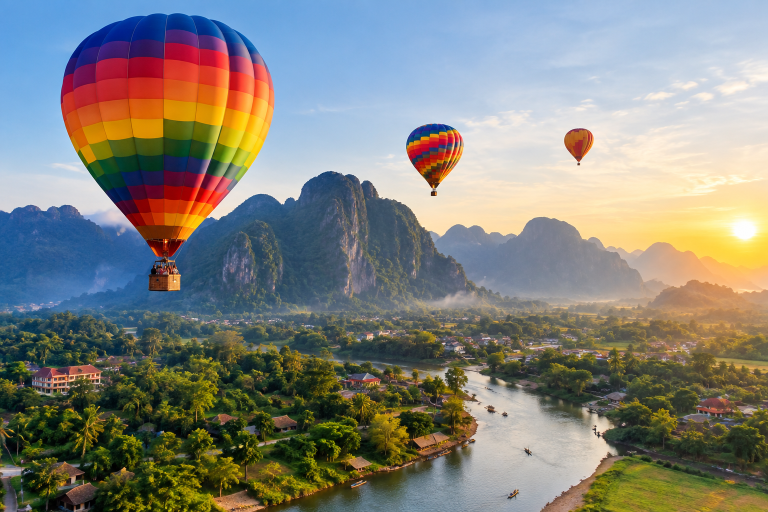
Vang Vieng
is a spectacular riverside town surrounded by limestone mountains, caves, lagoons and lush countryside, offering adventure, relaxation, kayaking, hiking and unforgettable natural scenery.
Located...
The Plain of Jars
Is one of the most truly mystifying megalithic archaeological landscapes in the world, renowned for thousands of massive, prehistoric stone vessels scattered across hillsides, hinting...
The Bolaven Plateau
is a stunning, plateau in southern Laos famous for its cool climate, cascading waterfalls, and lush coffee plantations, making it a paradise for nature lovers.
Rising dramatically from...
The 4,000 Islands
known in Lao as Si Phan Don, forms a tranquil Mekong archipelago in southern Laos, renowned for tropical scenery, peaceful islands, waterfalls, traditional villages and relaxed riverside...
Thakhek
The capital of Khammouane Province in central Laos, is a charming riverside town situated on the Mekong River opposite Thailand and known for its French colonial architecture, relaxed atmosphere...
Luang Namtha
the gateway to spectacular mountains, forests and ethnic villages. Its diverse hill tribes preserve distinctive traditions, crafts and ways of life, offering visitors authentic cultural experiences.
Luang...
Vientiane
the peaceful Laos capital, blends historic temples, French colonial architecture, vibrant markets, Mekong riverside charm, and relaxed local life, offering visitors a fascinating cultural and...